

 Image 1 of 1
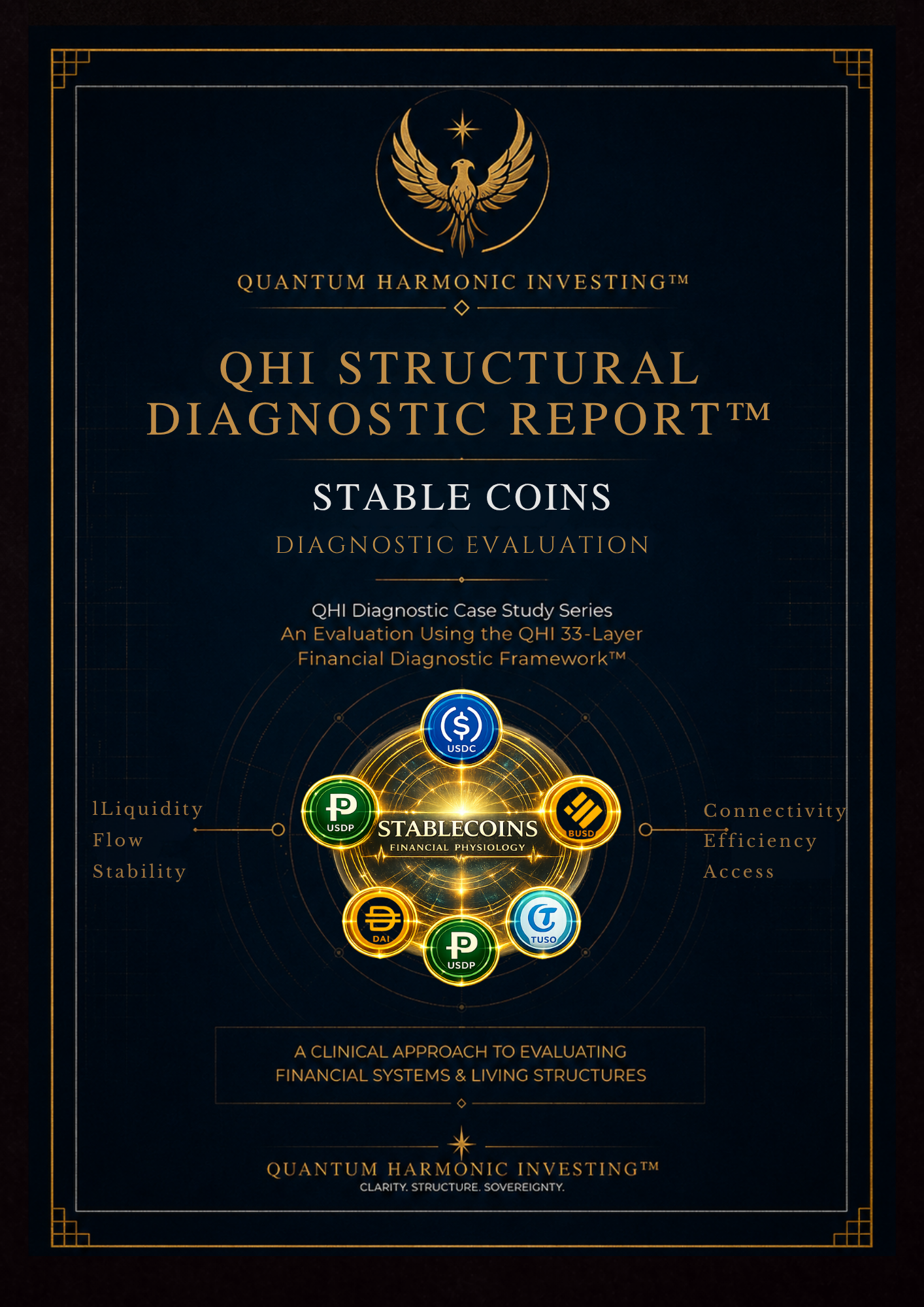
STABLECOINS — QHI Diagnostic Case Study Series
Part of the QHI Structural Diagnostic Report™ Series
Stablecoins evaluated through liquidity coordination, settlement infrastructure, and systemic financial integration — not speculation.
This report applies the QHI 33-Layer Financial Diagnostic Framework™ to the stablecoin ecosystem, evaluating stablecoins as operational financial infrastructure rather than simply digital dollar substitutes.
Using a clinical-style diagnostic methodology, the analysis examines stablecoins across multiple structural domains including Market Symptoms, Financial Labs, Structural Imaging, System Integrity, PCS Structural Classification™, Prognosis, and Capital Allocation Strategy.
Rather than focusing on short-term narratives or price appreciation, this report evaluates how stablecoins function within the evolving digital financial ecosystem — supporting liquidity flow, transactional stability, cross-border settlement, tokenization, and institutional financial coordination.
Within the QHI Financial Physiology™ model, stablecoins function as the cardiovascular liquidity system of the digital economy — maintaining the continuous movement of capital across interconnected financial networks.
The framework is designed to help readers interpret financial systems through structure, coherence, integration, durability, and long-term operational relevance.
Report Includes
• Executive Diagnostic Summary
• QHI 33-Layer Structural Evaluation
• Financial Physiology™ — The Cardiovascular Liquidity System
• Financial Symptoms, Labs & Structural Imaging
• PCS Structural Classification™
• Prognosis & System Trajectory Assessment
• Clinical Allocation & Capital Strategy
• Institutional-Style Diagnostic Methodology
We don’t speculate — we evaluate.
STABLECOINS — QHI Diagnostic Case Study Series
Part of the QHI Structural Diagnostic Report™ Series
Stablecoins evaluated through liquidity coordination, settlement infrastructure, and systemic financial integration — not speculation.
This report applies the QHI 33-Layer Financial Diagnostic Framework™ to the stablecoin ecosystem, evaluating stablecoins as operational financial infrastructure rather than simply digital dollar substitutes.
Using a clinical-style diagnostic methodology, the analysis examines stablecoins across multiple structural domains including Market Symptoms, Financial Labs, Structural Imaging, System Integrity, PCS Structural Classification™, Prognosis, and Capital Allocation Strategy.
Rather than focusing on short-term narratives or price appreciation, this report evaluates how stablecoins function within the evolving digital financial ecosystem — supporting liquidity flow, transactional stability, cross-border settlement, tokenization, and institutional financial coordination.
Within the QHI Financial Physiology™ model, stablecoins function as the cardiovascular liquidity system of the digital economy — maintaining the continuous movement of capital across interconnected financial networks.
The framework is designed to help readers interpret financial systems through structure, coherence, integration, durability, and long-term operational relevance.
Report Includes
• Executive Diagnostic Summary
• QHI 33-Layer Structural Evaluation
• Financial Physiology™ — The Cardiovascular Liquidity System
• Financial Symptoms, Labs & Structural Imaging
• PCS Structural Classification™
• Prognosis & System Trajectory Assessment
• Clinical Allocation & Capital Strategy
• Institutional-Style Diagnostic Methodology
We don’t speculate — we evaluate.